
Study SAT from Connecticut with 20 practice variants of 25 questions each, worked explanations, and original learning diagrams. The instructional bank is shared across states; geographical coverage means access to preparation, not a claim of a distinct local exam.

Overview
Exam Overview
Practice selected SAT algebra, advanced math, reading, and writing foundations with original questions and explained answers.
The exam owner defines the test content and candidate rules. This page organizes study resources for residents of Connecticut. Local test-center availability, institution policies, and registration arrangements must be checked separately; the page does not claim a state-specific version of the examination.
For state education services and jurisdiction referrals, use Connecticut official agency directory. For test administration, use the exam owner links below.
Official starting points
Scope
License Types
This is an exam study resource, not a state professional license. Follow the official exam owner and receiving institution for credential and admissions decisions.
Structure
Exam Format
Each ExamsLib variant contains 25 single-answer multiple-choice questions. The official exam may use different question types, adaptive delivery, section lengths, and scoring. Use the current official candidate guide for those details.
Score
Passing Score
The ExamsLib practice target is 72%, or 18 correct answers out of 25. It is an instructional target only, not an official passing score or a predicted result.
Eligibility
Requirements
The exam owner defines the test content and candidate rules. This page organizes study resources for residents of Connecticut. Local test-center availability, institution policies, and registration arrangements must be checked separately; the page does not claim a state-specific version of the examination.
Check current candidate policies with the exam owner and, where applicable, your school, employer, or testing jurisdiction.
Cost
Fees
Each exam includes three free practice tests. Additional practice tests require a paid plan. Official application, examination, rescheduling, and credential fees are set by the relevant organization. Check its current fee schedule before registering; no official fee amount is asserted here.
Plan Ahead
Study Plan
Your preparation roadmap
- 01
Build your baseline
Take variants 1-5 without rushing. Classify every missed answer by topic and misconception.
- 02
Strengthen weak topics
Study the weakest topics and complete variants 6-10. Explain the reasoning aloud before selecting a choice.
- 03
Practice with a timer
Use the optional 40-minute practice timer for variants 11-15. Record time spent and distinguish knowledge gaps from rushed reading.
- 04
Review and consolidate
Finish variants 16-20. Rework missed questions from scratch and compare topic-level error patterns. Confirm official exam logistics separately.
Topics to focus on
- SAT Algebra FoundationsPractice linear equations, inequalities, systems, ratios, and interpretations of slope and intercept.
- SAT Advanced Math FoundationsStudy quadratics, exponential models, rational expressions, radicals, function composition, and transformations.
- SAT Reading and EvidenceAnalyze original short passages for central ideas, supported inferences, vocabulary, evidence, and paired perspectives.
- SAT Writing and RevisionPractice sentence boundaries, agreement, modifiers, parallelism, transitions, concision, and goal-directed synthesis.
Worked examples
Practice walkthrough
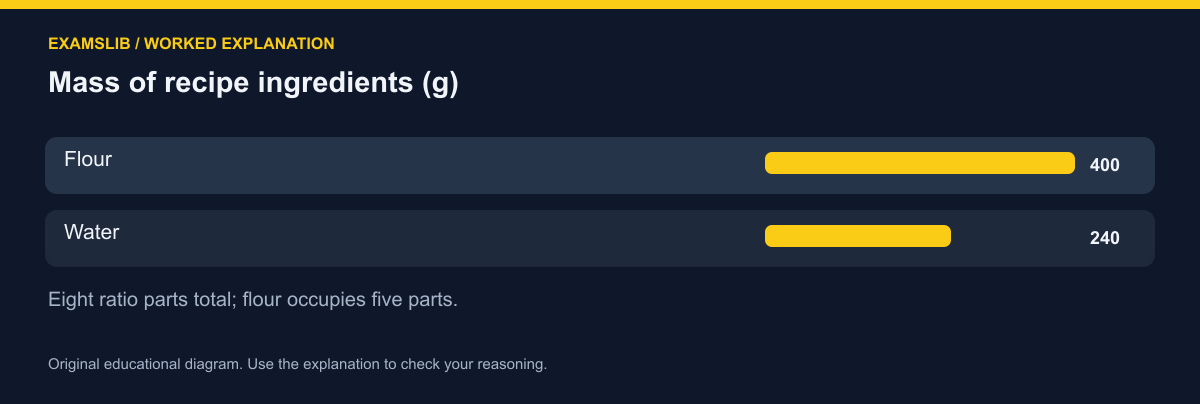
A recipe uses flour and water in a mass ratio of 5:3. If the mixture contains only these ingredients and has mass 640 g, how much is flour?
Answer: 400 g
There are 8 equal ratio parts in all. Flour is 5/8 of the mixture, so (5/8)(640) = 400 g.
Practice walkthrough
Which inequality describes spending at most $150 on x notebooks costing $6 each and one bag costing $30?
Answer: 6x + 30 <= 150
Notebook cost is 6x and the fixed bag cost is 30. At most means less than or equal to the budget of 150.
All 20 practice variants
- Practice variant 1
- Practice variant 2
- Practice variant 3
- Practice variant 4
- Practice variant 5
- Practice variant 6
- Practice variant 7
- Practice variant 8
- Practice variant 9
- Practice variant 10
- Practice variant 11
- Practice variant 12
- Practice variant 13
- Practice variant 14
- Practice variant 15
- Practice variant 16
- Practice variant 17
- Practice variant 18
- Practice variant 19
- Practice variant 20
Focus Areas
Study Topics
SF SAT Algebra Foundations
Practice linear equations, inequalities, systems, ratios, and interpretations of slope and intercept.
Study this topicSF SAT Advanced Math Foundations
Study quadratics, exponential models, rational expressions, radicals, function composition, and transformations.
Study this topicSR SAT Writing and Revision
Practice sentence boundaries, agreement, modifiers, parallelism, transitions, concision, and goal-directed synthesis.
Study this topicSE SAT Reading and Evidence
Analyze original short passages for central ideas, supported inferences, vocabulary, evidence, and paired perspectives.
Study this topic
Keep Exploring
Related Pages
Frequently asked questions
Are these questions unique to Connecticut?
No. The state directory links to a shared foundational question bank. The same practice number uses the same questions across states.
Does this page prove an exam or license is required?
No. A preparation page does not establish a licensing requirement, test availability, or eligibility. Check the official authority for your intended credential and location.
How many practice variants are available?
There are 20 variants, each with 25 questions and explanations. The variants have different sets; some questions recur between variants in new exam banks.
Can I use the practice score as an official result?
No. Practice percentages are learning feedback and are not comparable to official scaled, adaptive, or credentialing scores.
