
Study Plumbing Exam from Tennessee with 20 practice variants of 25 questions each, worked explanations, and original learning diagrams. The instructional bank is shared across states; geographical coverage means access to preparation, not a claim of a distinct local exam.

Overview
Exam Overview
Water supply, drainage and venting concepts, pipe measurements, and code navigation.
Identify the authority having jurisdiction and the applicable credential before selecting a reference. Fixture-unit tables, venting methods, and material rules are code-specific; these general exercises do not replace the locally adopted code.
Use Tennessee government and agency directory to locate the relevant state agency. For a municipal trade credential, verify the city or county where the work will occur.
Official starting points
Scope
License Types
This page provides subject preparation. It does not establish the existence of a statewide license, authorize professional work, or issue a credential.
Structure
Exam Format
Each ExamsLib variant contains 25 single-answer multiple-choice questions. The official exam may use different question types, adaptive delivery, section lengths, and scoring. Use the current official candidate guide for those details.
Score
Passing Score
The ExamsLib practice target is 72%, or 18 correct answers out of 25. It is an instructional target only, not an official passing score or a predicted result.
Eligibility
Requirements
Identify the authority having jurisdiction and the applicable credential before selecting a reference. Fixture-unit tables, venting methods, and material rules are code-specific; these general exercises do not replace the locally adopted code.
Requirements can change. Always confirm current licensing rules with the official state or local licensing authority before applying.
Cost
Fees
Each exam includes three free practice tests. Additional practice tests require a paid plan. Official application, examination, rescheduling, and credential fees are set by the relevant organization. Check its current fee schedule before registering; no official fee amount is asserted here.
Plan Ahead
Study Plan
Your preparation roadmap
- 01
Build your baseline
Take variants 1-5 without rushing. Classify every missed answer by topic and misconception.
- 02
Strengthen weak topics
Study the weakest topics and complete variants 6-10. Explain the reasoning aloud before selecting a choice.
- 03
Practice with a timer
Use the optional 40-minute practice timer for variants 11-15. Record time spent and distinguish knowledge gaps from rushed reading.
- 04
Review and consolidate
Finish variants 16-20. Rework missed questions from scratch and compare topic-level error patterns. Confirm official exam logistics separately.
Topics to focus on
- Water Supply SystemsStudy water supply systems for your plumbing exam. Covers pipe materials, sizing, backflow prevention, water heaters, and T&P relief valves.
- Drainage and Vent SystemsStudy drain, waste, and vent systems for your plumbing exam. Covers traps, pipe slope, venting methods, critical distance, and DWV sizing.
- Plumbing CodeStudy plumbing code for your licensing exam. Covers UPC vs IPC, permit and inspection process, fixture requirements, cross-connection control, and ADA rules.
Worked examples
Practice walkthrough
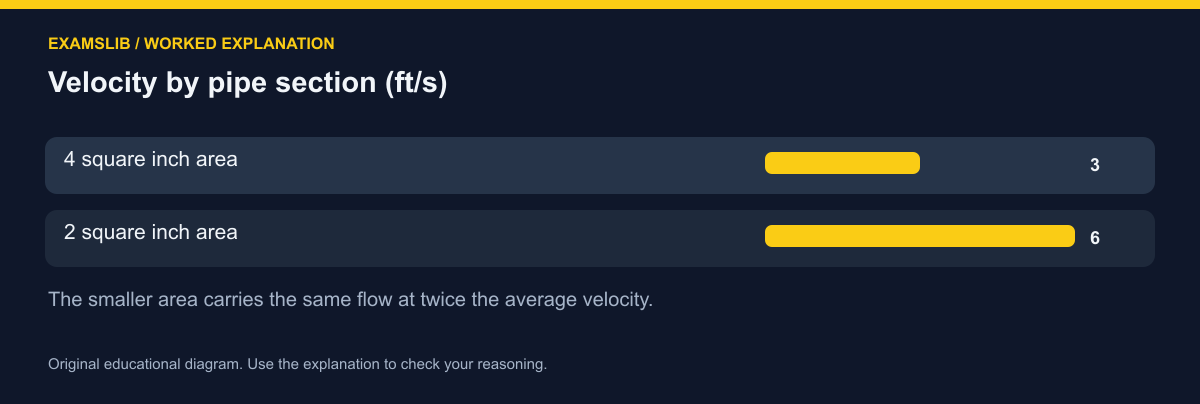
In a steady incompressible-flow exercise with no branches or leakage, a pipe area decreases from 4 square inches to 2 square inches. If average velocity in the larger section is 3 ft/s, what is average velocity in the smaller section?
Answer: 6 ft/s
Continuity gives area × velocity equal at both sections. Thus 4 × 3 = 2 × v, so v = 6 ft/s. Halving flow area doubles average velocity when flow rate remains constant. This relation alone does not calculate pressure loss.
Practice walkthrough
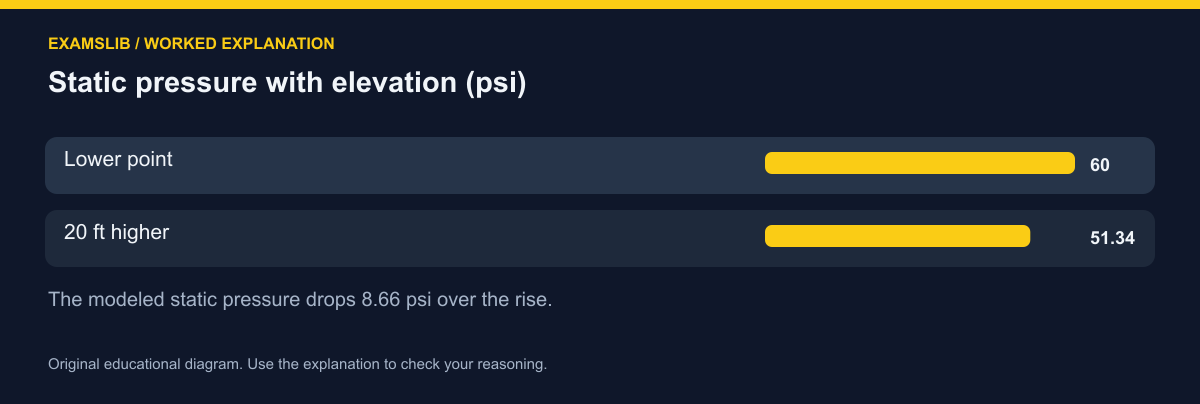
For a static-water exercise, use a pressure decrease of 0.433 psi for each foot of elevation gain. Water pressure at a lower point is 60 psi. Neglect friction. What pressure is predicted 20 ft higher?
Answer: 51.34 psi
The elevation pressure change is 20 × 0.433 = 8.66 psi. Pressure decreases with elevation, so the upper pressure is 60 − 8.66 = 51.34 psi. The 8.66 psi value is the decrease, not the remaining pressure. The no-friction condition is part of the model.
All 20 practice variants
- Practice variant 1
- Practice variant 2
- Practice variant 3
- Practice variant 4
- Practice variant 5
- Practice variant 6
- Practice variant 7
- Practice variant 8
- Practice variant 9
- Practice variant 10
- Practice variant 11
- Practice variant 12
- Practice variant 13
- Practice variant 14
- Practice variant 15
- Practice variant 16
- Practice variant 17
- Practice variant 18
- Practice variant 19
- Practice variant 20
Focus Areas
Study Topics
WS Water Supply Systems
Study water supply systems for your plumbing exam. Covers pipe materials, sizing, backflow prevention, water heaters, and T&P relief valves.
Study this topicDS Drainage and Vent Systems
Study drain, waste, and vent systems for your plumbing exam. Covers traps, pipe slope, venting methods, critical distance, and DWV sizing.
Study this topicPC Plumbing Code
Study plumbing code for your licensing exam. Covers UPC vs IPC, permit and inspection process, fixture requirements, cross-connection control, and ADA rules.
Study this topic
Keep Exploring
Related Pages
Frequently asked questions
Are these questions unique to Tennessee?
No. The state directory links to a shared foundational question bank. The same practice number uses the same questions across states.
Does this page prove an exam or license is required?
No. A preparation page does not establish a licensing requirement, test availability, or eligibility. Check the official authority for your intended credential and location.
How many practice variants are available?
There are 20 variants, each with 25 questions and explanations. The variants have different sets; some questions recur between variants in new exam banks.
Can I use the practice score as an official result?
No. Practice percentages are learning feedback and are not comparable to official scaled, adaptive, or credentialing scores.
