
Study Electrician Exam from New Mexico with 20 practice variants of 25 questions each, worked explanations, and original learning diagrams. The instructional bank is shared across states; geographical coverage means access to preparation, not a claim of a distinct local exam.
Overview
Exam Overview
Electrical fundamentals, grounding and bonding, load calculations, and code-reading skills.
Record the licensing jurisdiction and credential level first. Match the exam bulletin to its specified code edition and amendments before studying code-dependent limits. A national electrical code publication does not establish the licensing rule for every jurisdiction.
Use New Mexico government and agency directory to locate the relevant state agency. For a municipal trade credential, verify the city or county where the work will occur.
Official starting points
Scope
License Types
This page provides subject preparation. It does not establish the existence of a statewide license, authorize professional work, or issue a credential.
Structure
Exam Format
Each ExamsLib variant contains 25 single-answer multiple-choice questions. The official exam may use different question types, adaptive delivery, section lengths, and scoring. Use the current official candidate guide for those details.
Score
Passing Score
The ExamsLib practice target is 72%, or 18 correct answers out of 25. It is an instructional target only, not an official passing score or a predicted result.
Eligibility
Requirements
Record the licensing jurisdiction and credential level first. Match the exam bulletin to its specified code edition and amendments before studying code-dependent limits. A national electrical code publication does not establish the licensing rule for every jurisdiction.
Requirements can change. Always confirm current licensing rules with the official state or local licensing authority before applying.
Cost
Fees
Each exam includes three free practice tests. Additional practice tests require a paid plan. Official application, examination, rescheduling, and credential fees are set by the relevant organization. Check its current fee schedule before registering; no official fee amount is asserted here.
Plan Ahead
Study Plan
Your preparation roadmap
- 01
Build your baseline
Take variants 1-5 without rushing. Classify every missed answer by topic and misconception.
- 02
Strengthen weak topics
Study the weakest topics and complete variants 6-10. Explain the reasoning aloud before selecting a choice.
- 03
Practice with a timer
Use the optional 40-minute practice timer for variants 11-15. Record time spent and distinguish knowledge gaps from rushed reading.
- 04
Review and consolidate
Finish variants 16-20. Rework missed questions from scratch and compare topic-level error patterns. Confirm official exam logistics separately.
Topics to focus on
- Grounding and BondingStudy grounding and bonding for your electrician licensing exam. Covers NEC Article 250, GEC sizing, EGC sizing, main bonding jumpers, and common mistakes.
- Load CalculationsMaster electrical load calculations for your journeyman or master electrician exam. Covers NEC Article 220, demand factors, residential and commercial methods.
- NEC CodeStudy NEC code for your electrician licensing exam. Learn the code structure, key articles, open-book navigation tips, and closed-book memorization strategies.
Worked examples
Practice walkthrough
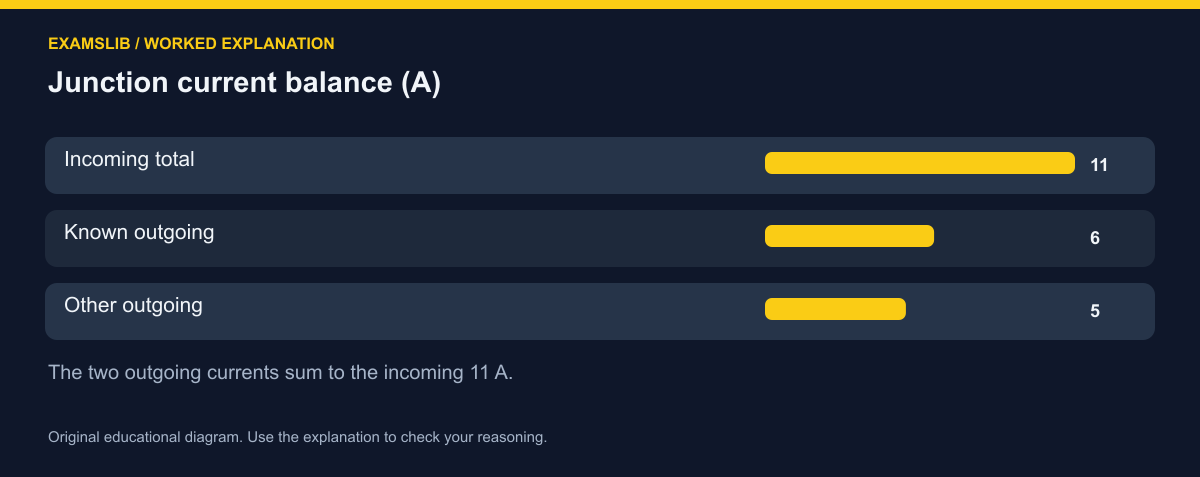
At an ideal circuit junction, 7 A and 4 A flow into the junction. One outgoing branch carries 6 A. What current must flow through the only other outgoing branch?
Answer: 5 A
Charge does not accumulate at the ideal junction, so total incoming current equals total outgoing current. Incoming current is 7 + 4 = 11 A. After subtracting the known 6 A outgoing branch, the remaining branch carries 5 A. Incoming and outgoing directions must be tracked before adding or subtracting.
Practice walkthrough
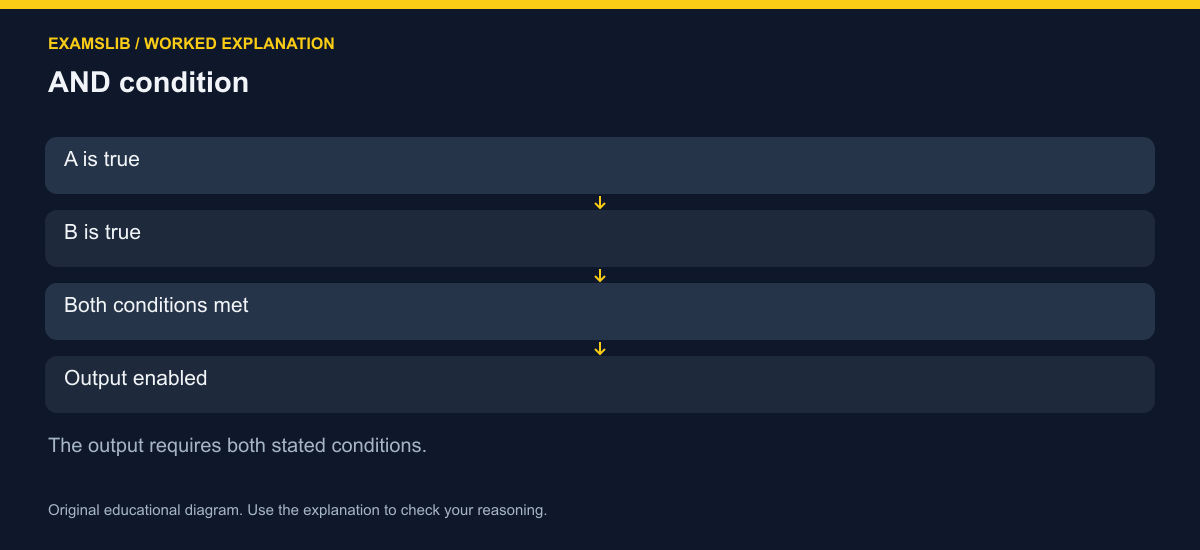
A hypothetical control enables an output only when both input A and input B are true. Which input condition enables it?
Answer: A true and B true
The stated condition is the logical AND function. Both inputs must be true at the same time. An OR function would accept either true input, but that is not the rule in this problem. This is a logic exercise, not a wiring or bypass procedure.
All 20 practice variants
- Practice variant 1
- Practice variant 2
- Practice variant 3
- Practice variant 4
- Practice variant 5
- Practice variant 6
- Practice variant 7
- Practice variant 8
- Practice variant 9
- Practice variant 10
- Practice variant 11
- Practice variant 12
- Practice variant 13
- Practice variant 14
- Practice variant 15
- Practice variant 16
- Practice variant 17
- Practice variant 18
- Practice variant 19
- Practice variant 20
Focus Areas
Study Topics
GB Grounding and Bonding
Study grounding and bonding for your electrician licensing exam. Covers NEC Article 250, GEC sizing, EGC sizing, main bonding jumpers, and common mistakes.
Study this topicLC Load Calculations
Master electrical load calculations for your journeyman or master electrician exam. Covers NEC Article 220, demand factors, residential and commercial methods.
Study this topicNC NEC Code
Study NEC code for your electrician licensing exam. Learn the code structure, key articles, open-book navigation tips, and closed-book memorization strategies.
Study this topic
Keep Exploring
Related Pages
Frequently asked questions
Are these questions unique to New Mexico?
No. The state directory links to a shared foundational question bank. The same practice number uses the same questions across states.
Does this page prove an exam or license is required?
No. A preparation page does not establish a licensing requirement, test availability, or eligibility. Check the official authority for your intended credential and location.
How many practice variants are available?
There are 20 variants, each with 25 questions and explanations. The variants have different sets; some questions recur between variants in new exam banks.
Can I use the practice score as an official result?
No. Practice percentages are learning feedback and are not comparable to official scaled, adaptive, or credentialing scores.
