
Study Contractor License Exam from Indiana with 20 practice variants of 25 questions each, worked explanations, and original learning diagrams. The instructional bank is shared across states; geographical coverage means access to preparation, not a claim of a distinct local exam.
Overview
Exam Overview
Estimating, project documentation, business fundamentals, and building-code reasoning.
Separate an individual trade credential from a business registration, contractor license, and permit. Project scope and the location of the work matter. A general study set does not establish that a statewide general-contractor examination exists.
Use Indiana government and agency directory to locate the relevant state agency. For a municipal trade credential, verify the city or county where the work will occur.
Official starting points
Scope
License Types
This page provides subject preparation. It does not establish the existence of a statewide license, authorize professional work, or issue a credential.
Structure
Exam Format
Each ExamsLib variant contains 25 single-answer multiple-choice questions. The official exam may use different question types, adaptive delivery, section lengths, and scoring. Use the current official candidate guide for those details.
Score
Passing Score
The ExamsLib practice target is 72%, or 18 correct answers out of 25. It is an instructional target only, not an official passing score or a predicted result.
Eligibility
Requirements
Separate an individual trade credential from a business registration, contractor license, and permit. Project scope and the location of the work matter. A general study set does not establish that a statewide general-contractor examination exists.
Requirements can change. Always confirm current licensing rules with the official state or local licensing authority before applying.
Cost
Fees
Each exam includes three free practice tests. Additional practice tests require a paid plan. Official application, examination, rescheduling, and credential fees are set by the relevant organization. Check its current fee schedule before registering; no official fee amount is asserted here.
Plan Ahead
Study Plan
Your preparation roadmap
- 01
Build your baseline
Take variants 1-5 without rushing. Classify every missed answer by topic and misconception.
- 02
Strengthen weak topics
Study the weakest topics and complete variants 6-10. Explain the reasoning aloud before selecting a choice.
- 03
Practice with a timer
Use the optional 40-minute practice timer for variants 11-15. Record time spent and distinguish knowledge gaps from rushed reading.
- 04
Review and consolidate
Finish variants 16-20. Rework missed questions from scratch and compare topic-level error patterns. Confirm official exam logistics separately.
Topics to focus on
- Business and LawStudy business and law for the Florida contractor licensing exam. Covers Chapter 489, lien law, workers' comp, contract law, and OSHA requirements.
- EstimatingStudy construction estimating for the contractor license exam. Covers quantity takeoffs, unit costs, overhead, profit, markup vs. margin, and bid calculations.
- Building CodeStudy building code for the Florida contractor exam. Covers FBC, occupancy classification, means of egress, fire resistance, and wind and flood rules.
Worked examples
Practice walkthrough
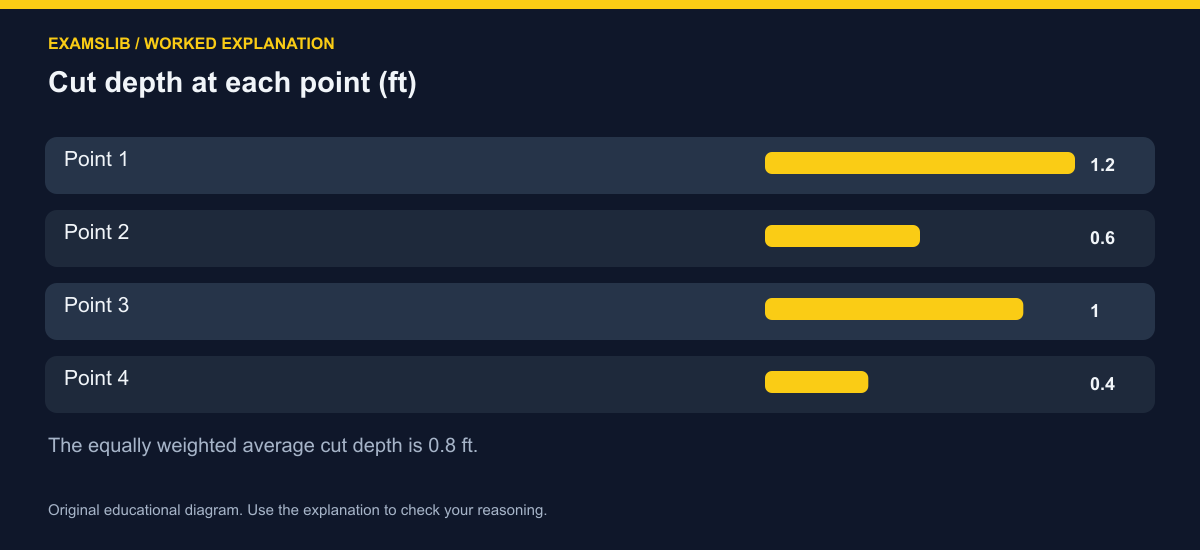
A grading exercise has existing spot elevations of 103.2 ft, 102.6 ft, 103.0 ft, and 102.4 ft at four equally weighted points. The target elevation is 102.0 ft at every point. Using the simple average-depth method over 900 square feet, what cut volume is estimated?
Answer: 720 cubic feet
The cut depths are 1.2, 0.6, 1.0, and 0.4 ft. Their average is (1.2 + 0.6 + 1.0 + 0.4) / 4 = 0.8 ft. The specified average-depth estimate is 900 × 0.8 = 720 cubic feet. This is a supplied simplified estimating method, not a claim that four points fully describe every real surface.
Practice walkthrough
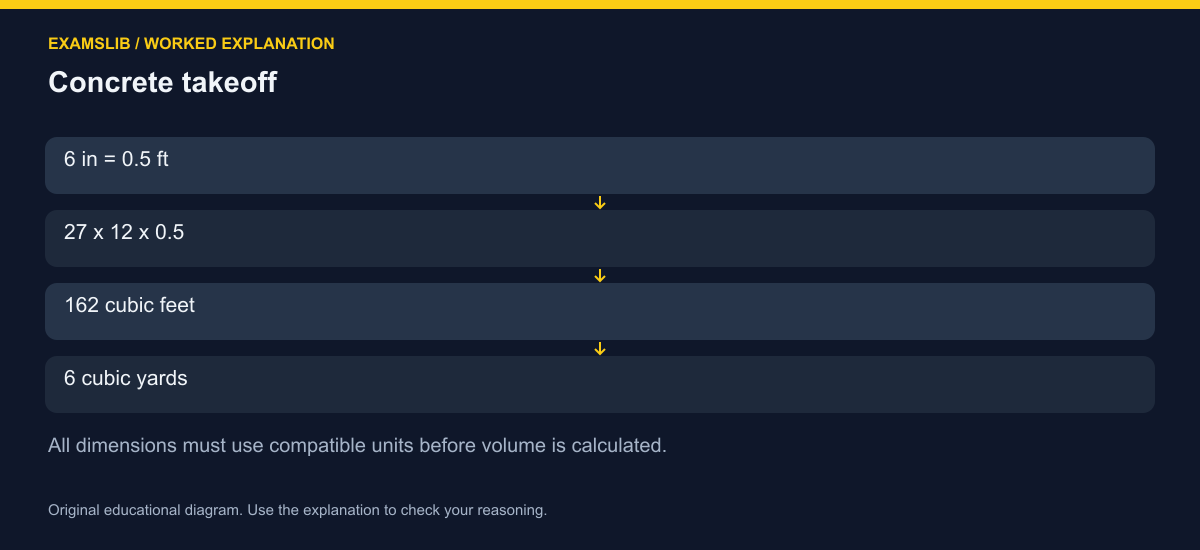
A rectangular slab is 27 ft long, 12 ft wide, and 6 inches thick. Ignore waste and use 27 cubic feet per cubic yard. How many cubic yards of concrete are required?
Answer: 6 cubic yards
Convert 6 inches to 0.5 ft before multiplying dimensions. Volume is 27 × 12 × 0.5 = 162 cubic feet. Divide by 27 cubic feet per cubic yard to obtain 6 cubic yards. Keeping thickness in inches would make the units inconsistent.
All 20 practice variants
- Practice variant 1
- Practice variant 2
- Practice variant 3
- Practice variant 4
- Practice variant 5
- Practice variant 6
- Practice variant 7
- Practice variant 8
- Practice variant 9
- Practice variant 10
- Practice variant 11
- Practice variant 12
- Practice variant 13
- Practice variant 14
- Practice variant 15
- Practice variant 16
- Practice variant 17
- Practice variant 18
- Practice variant 19
- Practice variant 20
Focus Areas
Study Topics
BL Business and Law
Study business and law for the Florida contractor licensing exam. Covers Chapter 489, lien law, workers' comp, contract law, and OSHA requirements.
Study this topicE Estimating
Study construction estimating for the contractor license exam. Covers quantity takeoffs, unit costs, overhead, profit, markup vs. margin, and bid calculations.
Study this topicBC Building Code
Study building code for the Florida contractor exam. Covers FBC, occupancy classification, means of egress, fire resistance, and wind and flood rules.
Study this topic
Keep Exploring
Related Pages
Frequently asked questions
Are these questions unique to Indiana?
No. The state directory links to a shared foundational question bank. The same practice number uses the same questions across states.
Does this page prove an exam or license is required?
No. A preparation page does not establish a licensing requirement, test availability, or eligibility. Check the official authority for your intended credential and location.
How many practice variants are available?
There are 20 variants, each with 25 questions and explanations. The variants have different sets; some questions recur between variants in new exam banks.
Can I use the practice score as an official result?
No. Practice percentages are learning feedback and are not comparable to official scaled, adaptive, or credentialing scores.
